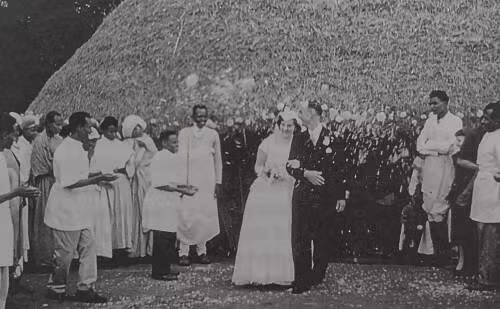
“Who shall I send, and who will go for me?” As a teenager, Bruce Bond was deeply moved by this verse from Isaiah. He felt God speaking directly to him, calling him into mission work. Around the same time, Norene, shaped by a strong mission heritage and her own sense of calling, was preparing for overseas service. Through shared studies and experiences, the two met, discovered a mutual passion for ministry, and became engaged.
“These are wonderful days to be in Ethiopia because people are so hungry for God’s word.”
Bruce left for Ethiopia by ship in 1954. Norene followed a year later after completing her studies at BTI (now Laidlaw). With training in agriculture and teaching, their first assignment was at the leprosarium in Shashamane, 240 km south of Addis Ababa, where they began a school, agricultural work, and rehabilitation programmes for patients.
Bruce later said, “When I first heard of God’s call for … missionary work I was disappointed at having to give up my cherished ambition of living and working on the land. But now God was opening up to us a lifestyle and challenge way beyond our expectations … not only could they (those at Shashamane) be helped physically but we would have constant opportunities to share God’s word with them … little did we realise then that many of these patients … once cured of leprosy, would return to their homes as God’s messengers to establish new churches throughout southern Ethiopia.”
Their years in Shashamane were rewarding yet demanding. One of the hardest sacrifices was sending their children to boarding school at Bingham Academy in Addis Ababa. Bruce remembered, “No homeschooling was permitted in those days … from the time our children were born, we had tried to condition ourselves for this painful separation … God had given us these precious children as gifts, and yet we knew we must not clutch them to ourselves, but rather hold them with an open hand so he could continue to use us in his service.”
After ten years, they moved into a new phase of ministry – first church planting in the highlands, then to Dilla.
Bruce recalled, “Our next assignment was to Dilla, Gedeo … about three hours south of Shashamane … my initial assignment was to teach in the Bible school.” Norene taught in the women’s school, while Bruce later became mission station head. Growth was rapid:
“The number of churches had doubled every two years, as had the number of believers. Evangelists had been sent out to at least three other tribal areas, and many students had graduated from the Dilla and nearby Yirga Chaffee Bible schools.”
After many years overseas, the Bonds returned to New Zealand. Bruce became director of SIM NZ for 15 years, a period marked by his strong leadership. Soon after their return home, Ethiopia faced famine, the monarchy collapsed, and Marxism took control. Many missionaries, including New Zealanders, had to leave the country. This affected SIM NZ significantly, yet under Bruce’s guidance, membership grew again, and with support from Howick Baptist, the SIM NZ office building was established and fully funded.
Ethiopia, however, remained close to their hearts. After equipping new leaders in New Zealand, Bruce and Norene returned to work at the SIM retreat centre in Bishoftu, supporting Christians suffering under the communist regime. During this time, the government granted land in a dormant volcanic crater for an orphanage for children affected by war. Kuriftu Children’s Centre emerged, with agricultural initiatives and an assembly hall that was designed and prefabricated in New Zealand.
Bruce wrote, “Our local Christians are so excited about the progress of this building … during this past month, at least 40 new believers have been added to our number. These are wonderful days to be in Ethiopia because people are so hungry for God’s word.”
Living in a container home, the Bonds chose to stay despite unrest. Norene’s gift of hospitality became a vital ministry. “We often witnessed the Ethiopian church members suffering greatly for their faith. But it was a privilege for us to be alongside them through their dark days. They had nowhere to run.”
At the request of the Kale Heywet Church and SIM, Bruce became director of SIM Ethiopia as the nation emerged from Marxism. Though planning to serve two years, they stayed for four. Their work in famine relief was significant: “We (SIM in Ethiopia) signed a contract with the government to provide wheat and aid for 105,000 people for three months. In all, we provided over 1200 large truck loads of wheat and 105,000 kg of edible oil…”
These efforts opened doors for the gospel, and new churches were planted. SIM and KHC established Bible colleges offering Amharic and English programmes. The Bonds also ministered to more than 40 families living outside the SIM compound; one couple said, “Had we not ended up here, we may never have heard about the Lord Jesus Christ.”
After retiring to New Zealand, they helped plant a Baptist church in Parakai. Returning to Ethiopia in 2003 for the 75th anniversary of the KHC, they said, “We really are Ethiopians even though our skin is white … the best years of our working lives were spent in Ethiopia.”