An interview with Dr Seble Daniel, director of the SIM East African Sending Office.
For generations, the word missionary has carried a typical image: someone from the Western world heading out to serve ‘elsewhere’. But across the global church, that picture is rapidly changing. The work of the SIM East African Sending Office offers a compelling glimpse of how mission today no longer West to the rest is, but everywhere to everywhere.
“Mission has become multi‑centred.”
Nowhere is this more evident than in Ethiopia. Long before the SIM East African Sending Office was formally established, the Ethiopian Kale Heywet Church – planted through the work of SIM missionaries – was already sending its own people beyond its borders. From the beginning, it was a church with a deep missional instinct, seeing both the responsibility and the privilege of participating in God’s work among the nations.
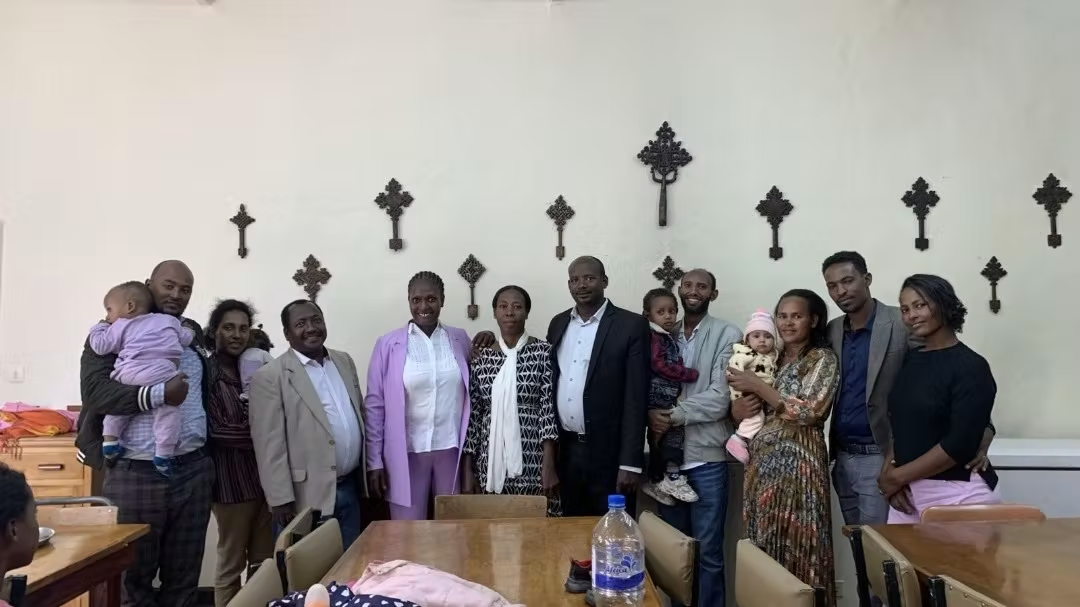
Today, that vision has borne remarkable fruit. 85% of the workers sent out through the SIM East African Sending Office are Ethiopian. Alongside them are others from Eritrea, Kenya, Uganda, and Rwanda. In total, 85 workers are serving across 14 countries in the Middle East, South Asia, and North, West, East, and Southern Africa, working in multi-cultural teams.
“When you say missionary, the first picture that comes to mind for many is a European person,” Seble reflects. “But that is changing slowly because we now have more workers from all over the world in SIM. It is beautifully captured by our global motto: from everywhere to everywhere. Nobody is just a receiver, and nobody is just a sender. We all receive and we all send, as the Spirit leads.”
Forged through suffering
The strength of Ethiopian missionaries cannot be separated from the history of the Ethiopian church itself. In God’s mysterious wisdom, seasons of intense suffering helped to shape a community of faith that is deeply rooted, prayerful, and committed to Scripture.
Under the communist regime, churches were closed and Christians faced imprisonment, persecution, and even death. And yet, rather than weakening the church, this season refined it.
“Because of that suffering, I think the church became resilient and much stronger,” Seble explains. “It created a stronger prayer life and commitment to the Scriptures. This has been a real asset for our workers.”
Wherever Ethiopian missionaries are sent, this legacy travels with them. Again and again, reports come back of workers marked by deep trust in God, persistent prayer, and a passionate desire to share the gospel – qualities that speak powerfully across cultures. And because of their limited resources, they are creative and yet also depend on their Creator.
Incarnational witness
In many contexts, Ethiopian workers also find that their presence opens unexpected doors. In West Africa, for example, their appearance allows them to blend naturally into communities, particularly among the Fulani, one of the largest nomadic ethnic groups across the region.
“The colour of their skin and the texture of their hair helps the workers blend in,” says Seble. “The chiefs and community leaders are welcoming them. The Lord is using this to help share the good news with the Fulani.”
Their economic background can also work in their favour. Coming from contexts where resources are limited, these workers are often seen as non‑threatening. Local communities are curious rather than suspicious, asking why they have come – and those questions become bridges for relationships. Their way of communal living also helps them build these connections.
“People do not assume there are hidden interests,” Seble explains. “Instead, they want to know the workers, and that helps them connect more deeply with the community.”
Mutuality in mission
“SIM is encouraging mutuality on a global scale,” Seble says.
At the heart of SIM East Africa’s approach is a strong commitment to mutuality – shared vision, shared leadership, and shared mission across the global church. Rather than a one‑directional flow of resources or personnel, mission becomes a cooperative endeavour.
Even though churches or agencies with greater financial resources make generous contributions, the primary support for Ethiopian missionaries comes from their own churches. As a result, they arrive in their place of service with substantial financial backing and strong prayer support from their sending congregations, alongside their spiritual depth, cultural insight and lived experience.
This diversity strengthens a united focus. Churches and missionaries bring different life experiences, perspectives, and gifts. As they support and encourage one another, they embody a richer picture of Christ’s body as the church.
Of course, this collaboration does not come without challenges. Differences in culture, language, and communication – particularly where English is not widely spoken – can make engagement more complex. But these challenges are not obstacles to mission; they are invitations to humility, listening, and learning.
“It is about trying to understand one another,” Seble reflects.
A multi‑centred mission
For some time now, SIM has been intentionally working toward shared leadership and a more polycentric understanding of mission. In this emerging reality, there is no single centre from which everything flows.
“God has now moved the centre of gravity of Christianity to the global South and to Africa,” Seble observes. “Mission has become multi‑centred.”
This shift does not diminish the role of any part of the church; instead, it enlarges it. God is calling his people – from every culture and context – to work together, learn from one another, and walk humbly side by side.
“God is bringing people from different places to work together,” Seble concludes. “To learn from each other, to be humble, and to listen – wherever we might be on our journey.”
And in that shared journey, the picture of mission is being reshaped – not by strategy alone, but by the Spirit’s quiet, powerful work among his people.
Pray for
- the children of mission workers, who experience frequent change, that God would provide stability and meet their educational and emotional needs
- God to open hearts to receive the gospel message
- safety and security for workers, and for clarity and boldness as they share the gospel