“ The immense concern for the least reached began with a mother, Margaret Gowans.”
Margaret had a great interest in missions and prayed for it often. Her passion was no doubt passed down to her children, particularly Walter Gowans. Margaret sensed a call for her son to go to the Sudan (or known as the ‘Soudan’), a large area that stretched from east to west Africa and had a population of sixty to ninety million without a single Christian. Walter himself desired to go to a place known today as northeast Nigeria.
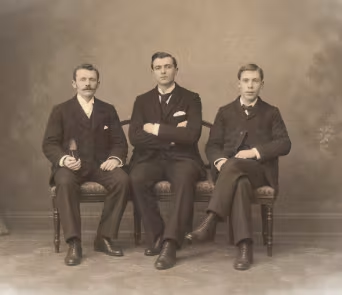
Later, at the New York Missionary Training Institute, Walter would meet both Thomas Kent and Rowland Bingham. Together they knew God was calling them to Central Soudan. They applied to mission boards in both North American and Britain, to no avail. Margaret Gowans however compelled them to go, “Are you prepared to go if God calls you?”
In 1893, God brought three lives together, to take the gospel message to Central Soudan, with or without the support of a mission board. Upon arriving in Lagos (Nigeria), they were warned time and time again how incredibly difficult it would be. Yet they pressed onwards and gave the name of their mission the ‘Soudan Interior Mission’.
After only being in Lagos for three weeks, Bingham became ill. He stayed there to recover. Gowans and Kent began their travel inland. Later, Kent returned to Lagos for more supplies and arrived very ill. After having some time to recover, Kent set out again to join Gowans. But that never happened. They were both plagued by sickness again and passed away.
When Bingham made the heart wrenching trip to Margaret Gowans to return some of Walter’s belongings, she cried, “I would rather have had Walter go out to the Soudan and die there, all alone, than have him home today, disobeying the Lord.”
The birth of a vision
Following the death of his friends, Bingham returned to a church in New York. He reiterated the great need for missionaries to go. A significant response to this need came from Toronto, Canada. It was here that Bingham was able to form a missionary council in 1898. This was to be known as the Africa Industrial Mission which then became the Africa Evangelistic Mission (AEM). Another change occurred when it was renamed the Sudan United Mission. But this name only lasted a year and then became the Sudan Interior Mission.
Later changes of the name took place in 1980 when it officially became SIM International (Society for International Ministry). In 1990 it was revised to the Society for International Ministries. Finally in 2000 it was changed to Serving in Mission.
It was during late 1926 and early 1927 that Rowland Bingham visited both Australia and New Zealand to speak on the need for missionaries and help establish councils that would facilitate people going out from Australasia. Councils were set up in Sydney, Melbourne and Auckland.
At the first council meeting in Auckland, Bingham outlined the following to define the responsibilities of the council:
- For the gospel to go to the Sudan
- Must be strong and true to the foundations of the faith
- Be committed to time: ‘should be given at least one evening per month, suggesting tea in town at 5.30pm then devote one and a half hours to prayer and conference, then the Executive that remain can attend to business’
- Stewards of the funds should take great care of them as if they were their own.
Referring to those that had already applied to the mission, it was stated that those over thirty years of age needed special qualifications, because of difficulties such as language. Applicants needed to be fully committed: ‘Lives must be wholly consecrated to Christ and must be active soul winners here.’
The foundation of SIM NZ was laid by those who believed that the gospel must reach the ends of the earth. Their courage and commitment echo through the decades, reminding us that the call to serve remains as urgent today as it was in 1893.
Want to learn more about the history of SIM? Take a look here at our history and read about ordinary people who stepped out to share the gospel in the world’s hardest places.